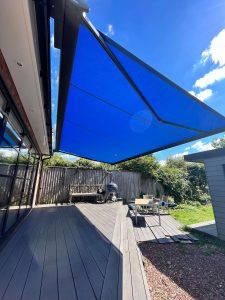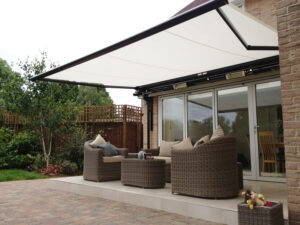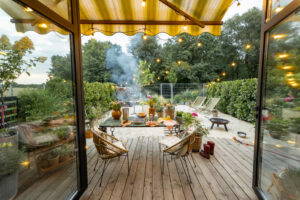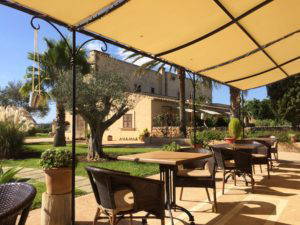
When homeowners start looking at patio coverings, it can be easy to assume the largest awning will automatically provide the best result. More projection means more coverage, so it can seem like the obvious choice. In practice, however, more coverage does not necessarily mean more useful shade.
The right projection depends on where you need shade, when you use the garden, how the sun reaches your patio, where your furniture is positioned, and whether you can install the awning on your property. If you mainly want shade over a small dining table close to the house, you might not need a particularly deep projection. If you regularly entertain on a much larger patio, then a bigger awning may make sense.
At Cambridge Awnings, when we survey a property, we look at how you use the space. We aim to recommend an awning that makes your garden more comfortable, without encouraging you to pay for extra size that doesn’t genuinely benefit you.
Start With the Area You Want to Shade
The size of your patio doesn’t necessarily tell us how large the awning needs to be. What matters more is the part of the space you regularly use.
For example, you might have a large paved patio but usually sit around a four-person dining table just outside your bifold doors. If that area becomes uncomfortable in direct sunlight, you might not need to extend shade across the entire patio. Another family might have a larger outdoor space with separate kitchen, dining and seating areas. In that case, more projection could be worthwhile because more of the patio is being used at the same time.
This is why we prefer to start with a simple question: what are you trying to make more comfortable? You might want shade for outdoor meals, a cooler spot for children to sit, protection from strong afternoon sunshine, or less heat and glare through large glazed doors. Once we know that, we can start working out how much projection is actually useful.
Projection and Shade Are Not the Same Thing
If an awning projects three metres from the building, it does not create a fixed three-metre rectangle of shade beneath it. The shadow position changes with the sun’s height and direction, the season, the mounting height and the awning’s pitch.
That is why choosing a projection from a brochure alone can be misleading. A technically larger awning may still fail to put shade where you expected at the time you most want to use the garden.
Think About When You Use the Patio
The sun’s position changes throughout the day, which means the shade beneath a retractable patio awning moves too. This is one reason we consider the property’s orientation and the sun path during a survey. A patio that gets strong midday sunshine can behave very differently from one that becomes uncomfortable later in the afternoon.
West-facing gardens are a good example. The lower evening sun can get underneath a covering at a much shallower angle, so increasing the projection doesn’t always solve the problem in the way a homeowner expects. Whereas a south-facing garden can experience strong sunlight for a longer part of the day, which creates a different set of requirements.
Rather than only looking at the size of your patio, we need to understand when you want to use it and where the shade needs to fall at those times. That gives us a much better basis for deciding what projection makes sense.
What Projection Sizes Are Available?
The available projection depends on the awning model, its width and the manufacturer’s specification. Domestic folding-arm awnings commonly offer projections around 2 metres, 2.5 metres, 3 metres and 3.5 metres, while selected larger systems may reach approximately 4 metres in suitable configurations.
The maximum available projection should not automatically become the target. The correct size still depends on the property, the fixing arrangement and where the useful shade needs to fall.
Look at Where Your Furniture Sits
Furniture placement is another useful way to judge how much coverage you really need. If the awning is mainly for outdoor dining, think beyond the table dimensions. People need enough shaded space to sit comfortably, move their chairs and use the area without constantly going in and out of direct sunlight.
The same applies to lounge furniture. If you have a sofa positioned away from the house, the awning might need to project further to make that part of the patio comfortable. If your seating area is much closer, a smaller projection may be perfectly adequate. You may also want part of the patio to remain uncovered. Some homeowners prefer a shaded dining area while keeping another section open for sunbathing when they want to.
We don’t see any benefit in covering every paving slab just because there is space available.
Mounting Height Can Affect the Projection
The awning’s position is just as important as the patio’s size. We need to consider where the system can safely be installed and how much height is available above doors, windows and other architectural features. Rooflines, gutters, drainage, wall construction and available fixing points can all influence the final installation.
This is important because the awning needs to be installed with an appropriate pitch. The pitch helps determine the clearance beneath the awning and also plays a key role in wet weather, as water needs somewhere to run off rather than collecting on the fabric. A very deep projection from a relatively low mounting position may therefore create practical issues.
We would be cautious about choosing a projection from a brochure before surveying your property. A measurement that looks right on paper still needs to work properly on the building.
Do Not Forget the Structure Behind the Wall
A patio awning can place substantial forces on its mounting points, so we assess more than the visible brickwork or render. Modern walls may include insulation systems, unusual cavities or cladding that require specialist brackets, chemical fixings or bespoke supporting steelwork.
This is another reason not to select the largest possible awning before the building has been properly surveyed.
Bigger Doesn’t Always Mean Better Shade
It’s worth separating more coverage from more useful shade. A larger awning will physically cover more space, but that doesn’t automatically mean the extra projection improves how you use your garden. If the extra metre extends over an area where nobody sits, you might be paying more without gaining much practical benefit.
Of course, there are situations where a larger system makes sense. You might have a large dining table positioned further away from the house or regularly host family and friends across the whole patio area. In these situations, extra projection has a clear purpose.
What we don’t believe in is recommending additional size simply because the property can accommodate it. If a smaller awning gives you the shade you need, that’s the better choice.
What If Your Garden Is Very Exposed?
A large folding-arm awning presents a significant surface area to the wind. A sheltered courtyard and a garden overlooking open countryside can therefore behave very differently, even with the same awning.
Wind performance and operating limits are product-specific. Whatever the rating, a retractable awning should be brought in early when conditions deteriorate rather than being left out to test its limit.
Should You Plan for Future Changes?
It can also be useful to think about how your garden might change over the next few years. Perhaps you currently have a small dining table but are already planning to replace it with a larger garden furniture set. You might be extending the patio, adding an outdoor kitchen area, or completely changing your garden layout.
If your plans are realistic, it makes sense to mention them during the survey. This doesn’t mean we will automatically recommend a larger awning just in case you decide to change things later. We would rather understand what’s actually planned and make a sensible decision around that.
There’s a difference between allowing for a known change and paying for additional projection that you might never end up using.
So, How Far Should a Patio Awning Project?
There isn’t a single answer to this question. The right projection gives you useful shade where you need it, while also working properly with your home’s layout and construction.
When we recommend awnings for patios, we consider the direction your property faces, how the sun moves across the garden, where your furniture sits, the available mounting height, and how you intend to use the space. From there, we can recommend a size that makes sense.
Sometimes that means choosing a deeper projection because it will noticeably improve how you use your patio. In other cases, a smaller retractable patio awning will comfortably cover the area that matters most. Our job isn’t to sell you the biggest awning that will fit on your wall. It’s to suggest the amount of coverage that genuinely works for your home.
If you are considering a patio awning and are unsure what projection you need, contact Cambridge Awnings to arrange a survey. We can look at the property, discuss how you use your outdoor space and recommend a size based on what will actually work — not simply what looks biggest in a brochure.