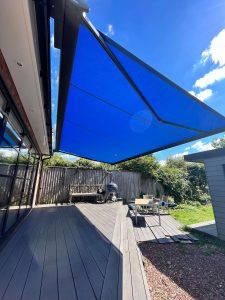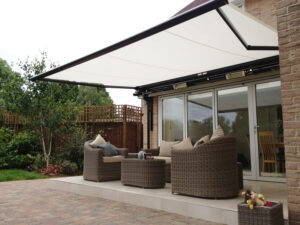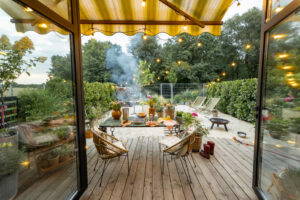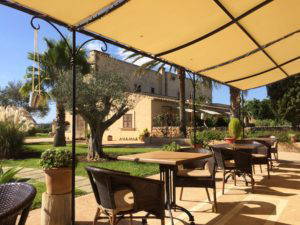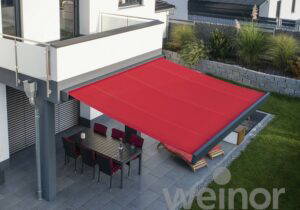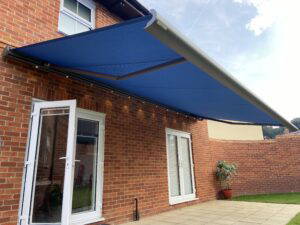
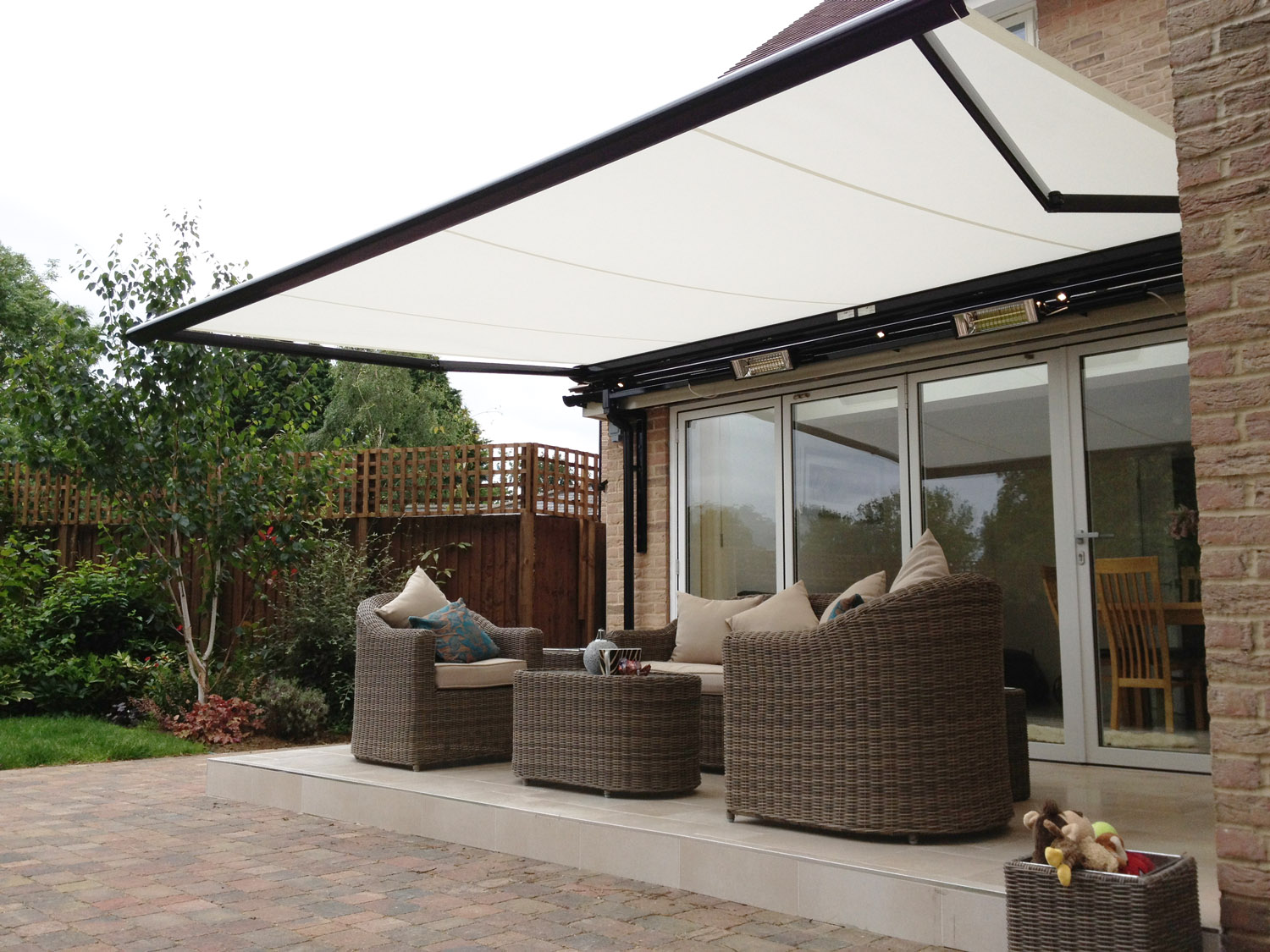
Before recommending a retractable awning, our team at Cambridge Awnings will consider how exposed the installation area is. While retracting the awning offers more control over shade in warmer weather, it’s important to ensure the system is safe.
Two gardens that look very similar can experience completely different conditions. One might be protected by neighbouring houses, fencing, and mature planting, while another might be next to open countryside or on higher ground where nothing slows the wind down.
An exposed position doesn’t automatically mean that retractable awnings are unsuitable. What it does mean is the garden needs to be assessed properly before deciding which product, size and installation approach makes the most sense.
How Much Wind Actually Reaches Your Patio?
When we talk about exposure, at Cambridge Awnings we’re interested in the conditions around the area you want to cover rather than whether your wider location is generally considered “windy”. Open countryside is an obvious example. If your garden backs directly onto fields, there might be very little between your patio and the incoming weather. Elevated properties or corner plots can also behave differently.
Surrounding buildings and landscaping often provide useful shelter, but can also redirect wind. This is one reason we prefer to assess every installation individually, rather than assuming an awning that works well on one property will automatically suit the house next door.
What Wind Speed Can a Retractable Awning Withstand?
There is no single wind speed that applies to every retractable awning. Tested performance varies by product, size and configuration, and the completed installation still depends on correct fixing to a suitable structure.
Wind resistance is commonly expressed using wind-resistance classes and the Beaufort scale. Some folding-arm awning guidance permits use up to Beaufort force 5 and requires retraction from force 6, but the relevant manufacturer’s instructions for the specific model must always take priority.
Published weather-station speeds may not represent conditions at patio level. Gusts, turbulence and wind funnelled around buildings all matter. If conditions are deteriorating, retract the awning early rather than seeing how much wind it can withstand.
The Size and Projection You Need
The amount of shade you want also affects which garden awnings you should install. It’s easy to assume the largest awning will give you the best result. In practice, bigger isn’t always better. We would rather establish where you actually need shade. If you mainly want to cover a dining table, for example, you might not need an awning extending across the full patio.
This is especially relevant in an exposed garden because the awning’s size and projection affect the overall installation assessment. Sun direction is also important. Shade doesn’t fall directly under an awning all day, so simply measuring the patio and choosing the largest possible projection isn’t necessarily the right approach.
Our aim is to create enough coverage to make the outdoor living space comfortable without selling you additional size that offers little practical benefit.
What is the Awning Being Fixed To?
When installing a fully retractable awning, we consider the wall, available fixing positions, rooflines and other structural features before deciding which design is best. This is especially important when properties have rendered finishes, insulation systems, or other construction details that mean straightforward fixings aren’t appropriate.
Over the years, we have worked on projects where the existing wall arrangement couldn’t safely accommodate the required awning installation in the normal way. In one case, we created a bespoke goalpost-style support structure instead, with supports running down the wall.
That doesn’t mean a complicated support system is always necessary when a wall presents a challenge. Sometimes there is a simpler solution. For us, the key is to choose a fixing method that suits the property, rather than forcing a product to fit regardless of the circumstances.
How Do You Want to Use Your Outdoor Space?
This is probably the most useful question we can ask. Traditional retractable awnings provide controllable shade, so if your plan is to extend the awning over your patio on warm days and retract it when conditions deteriorate, a conventional system might be exactly what you need.
Your requirements might be different if you want to use the area more frequently or your patio is regularly exposed to stronger weather. This is where we sometimes discuss pergola-style systems. Rather than projecting entirely from the property like a traditional folding-arm awning, they have posts at the front of the structure. This additional support can make a pergola-style system worth considering for certain more demanding locations or larger outdoor areas.
However, we wouldn’t recommend one simply because it’s more substantial or more expensive. If a standard retractable awning safely provides the shade you want and suits how you intend to use it, there’s no reason to upgrade to a pergola system.
Will Sensors Make an Exposed Location Suitable?
Wind, weather and product-protection sensors can be useful additions to motorised garden awnings. Depending on the system, sensors can help respond to changing conditions and provide additional reassurance when using an awning.
However, they shouldn’t compensate for a product installed in an unsuitable location. We see sensors as an additional safeguard, not a reason to ignore the garden’s characteristics. We would always rather start with an appropriate product, suitable sizing and a properly considered installation. Even with sensors, you play an important role too. If weather conditions become unsuitable, retract the awning as soon as possible rather than relying entirely on automation.
Wind Sensors and Vibration Sensors Are Not the Same
A conventional wind sensor monitors conditions at the sensor location. A vibration or motion sensor is fitted to the awning and reacts to movement of the front profile. Both can provide useful protection, but neither makes an unsuitable installation safe.
Sensors are an additional safeguard, not a substitute for sensible sizing, sound fixings or the homeowner retracting the awning when worsening conditions are apparent.
Think About Everyday Care as Well as Wind
Exposure also affects how an awning should be maintained once installed. For example, if it unexpectedly rains, you might need to retract the awning while the fabric is still damp. Then, once conditions improve, extend it again and let it dry completely.
Standing water should also be avoided. Correct pitch helps rainwater drain off the fabric instead of collecting on the awning, which is another reason you need to consider the installation angle properly. Not to mention, the surrounding area is important too. Patios under trees can experience bird droppings, leaves, or tree sap landing on the fabric. These shouldn’t be left indefinitely, particularly before the awning is retracted for longer periods.
In our experience, these small details can make a big difference in how well an awning looks and performs over time.
When Might We Recommend a Pergola System Instead?
Exposure is only one part of this decision. We might discuss a more supported pergola-style system when a garden is very open, when you need extensive coverage, or when your expectations go beyond occasional shade in settled conditions.
For the right garden, additional support can provide a genuine advantage. But this should always come back to what you actually need. A garden that experiences the occasional gust of wind doesn’t automatically require a pergola. Similarly, spending more on a larger system doesn’t make sense if a traditional awning already comfortably meets your needs.
Sometimes adjusting the projection, changing the position of the shaded area or choosing a more appropriate installation point can provide a much simpler answer.
Could External Screens Help?
Sometimes the real problem is low sun or solar gain through large areas of glazing rather than a need for overhead shade. Depending on the property, a vertical external zip screen may complement an awning or provide a more effective alternative.
The correct answer starts with the problem we are trying to solve — shade on the patio, glare through the glass, indoor overheating, or a combination of all three.
Choosing the Right Awning for an Exposed Garden
An exposed garden doesn’t necessarily rule out retractable awnings. It simply means you need to consider it during product selection. At Cambridge Awnings, we consider how wind reaches the patio, how much shade you need, what the awning will be fixed to, surrounding buildings and landscapes, and how you expect to use the space once the installation is complete.
Sometimes a straightforward retractable awning is the most sensible choice. Sometimes the additional support of a pergola-style system offers a genuine advantage. Occasionally, we may feel neither option is right for the proposed position, and we’ll tell you that too.
Our job isn’t to sell you the biggest or most expensive system. We want to understand your garden, explain the practical options and recommend the solution that genuinely suits your home. If a traditional retractable awning will do everything you need, we will recommend that. If it will not, we will explain why so you can make an informed decision. If your garden is particularly open or exposed, speak to Cambridge Awnings before choosing a product. A proper survey allows us to assess the building, local exposure and intended use, then explain what we believe will genuinely work.